


CENTRAL ILLINOIS — This is not your father’s Future Farmers of America.
Today’s FFA welcomes all students ready to learn skills for a career, or just life.
“It’s very different than it was 30 years ago, whereas every kid was from a farming background or grew up on a farm,” said Jaton Shaffer. “It’s definitely transitioned from that.”
Shaffer, a Blue Ridge 2021 graduate, is currently the FFA Illinois vice president. He came from a standard agriculture background, having grown up on a farm with corn and soybeans near Farmer City.
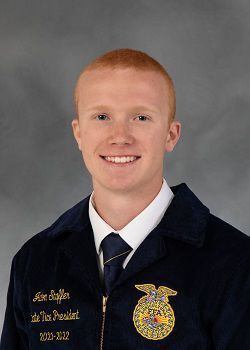
Shaffer
His father and grandfather both participated in FFA as high-schoolers.
“However, even in the small town of Farmer City, I believe I’m only one of four or five members that came from what we would consider a typical agriculture background,” Shaffer said. “Whereas most of our members found some way to be involved in the organization, whether that was because they enjoyed the opportunity to participate in a competition, meet new friends, or they just enjoyed that comradery and that family atmosphere.”
People are also reading…
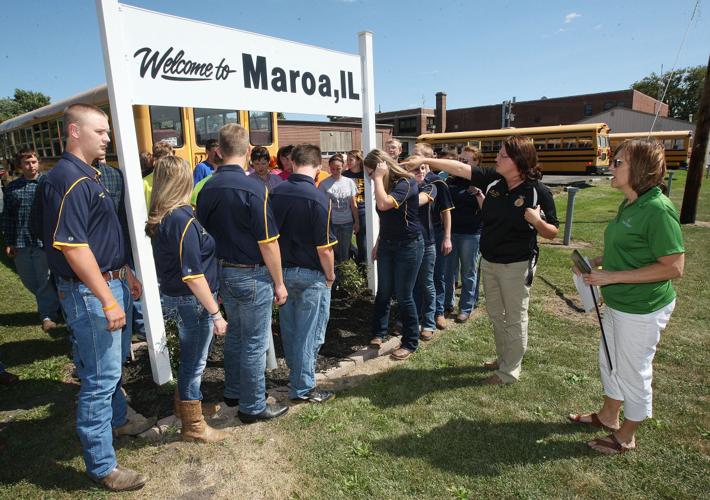
“We’re not all going to go back to the family farm,” said Maxwell Berry, Maroa-Forsyth High School student and Section 16 president.
Berry was not raised on a farm, but appreciates his responsibility to advocate for similar students. His grandfather was an FFA member as a high school student many years ago as well as his sister more recently.
“I saw how much it helped her grow as a person,” Berry said. “I said. ‘I want that.’ I want that experience to become better as a person and as an individual.”
According to Berry, approximately 20 percent of his FFA chapter does not have agriculture experience.
“But we live in the middle of a corn field, so we grew up seeing the harvesting season and the lovely smell of corn,” he said. “We get to live and experience agriculture in its purest form. We can still tell you what a tractor is, but not everyone can.”
Although FFA has changed, its roots have not.
“Our organization is at the base of agriculture, and that will never change,” Berry said.
Approximately 30 years ago, the name of the organization was changed slightly, from Future Farmers of America to simply the National FFA organization.
“The focus of the students involved in FFA did transition from people that were going to become farmers to people that were going to be in agriculture,” Shaffer said.
Careers span across several areas, including agronomist, seed sales, marketing, commodities and others.
“There’s just this insane variety of jobs within the agriculture field,” Shaffer said. “Those jobs became more prevalent, especially as we approached the '90s and now in the 2000s. A very small percentage of people involved in agriculture actually work on a farm.”
The organization isn’t just for the guys, either. Women became allowed to join FFA in 1969, according to the FFA archives.
Jacalyn Meisner was Shaffer’s FFA adviser at Blue Ridge High School. She has watched the rise in numbers of FFA members since she began her job six years ago. “And it’s not just in those local, rural communities, but across the state in urban areas as well,” she said.
Meisner teaches a variety of agriculture subjects, including ag business, plant and animal sciences, mechanics, communication and leadership skills, horticulture and others.
“There are several careers that they can go into that span a wide range of abilities,” she said. “But there’s also real-life skills. We teach them about budgeting, time management, and how to communicate.”
The students’ success is dependent on the level of participation, according to the advisers. Competitions range in categories, including individuals competing in a job interview contest or a group competing in parliamentary proceedings.
Meisner said s she doesn’t have to persuade many of the students to join the agriculture organization.
“I just tell them we are a leadership organization that supports agriculture,” she said. “If you like eating, if you like wearing clothes, that is all agricultural-based.”
According to Meisner, much of the encouragement comes from the members themselves. “We have a lot of fun and the kids really see that,” she said. “But we get things done.”
Unlike other members of his chapter, Shaffer had to be persuaded. “They literally chased him down,” Meisner said. “And he became our chapter treasurer by his sophomore year.”
Shaffer will spend the next year serving as the state’s FFA vice president. Afterward he plans to attend the University of Illinois in Urbana-Champaign to study agriculture and consumer economics.
“We take a gap year as part of our year of service for the organization,” he said.
FFA 2019
FFA
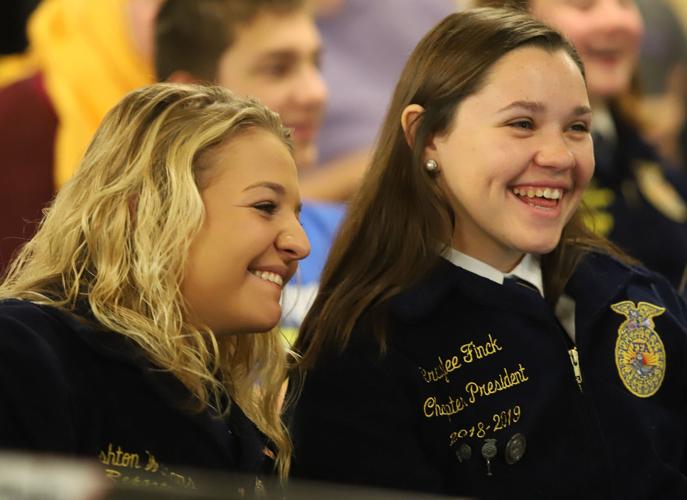
Maroa-Forsyth FFA members Ashton Williams, left, and Braylee Finck react to a video that was intended to be funny from a presenter during the Farm Credit Illinois farm safety expert presentations at the Maroa-Forsyth High School Ag Shop Thursday morning.
Contact Donnette Beckett at (217) 421-6983. Follow her on Twitter: @donnettebHR

Donnette Beckett
Features Reporter


