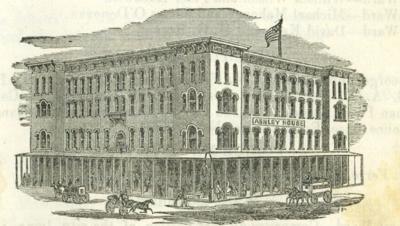


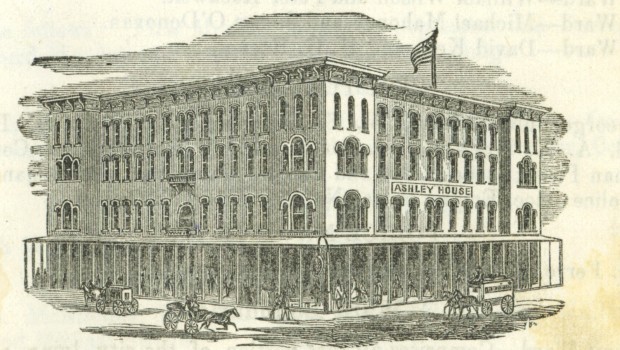
BLOOMINGTON — The Ashley House, Bloomington’s largest hotel from the Civil War until its fiery end in 1900, had a tumultuous history replete with financial shenanigans, legal entanglements and even the requisite sex scandal.
Located at the northwest corner of Center and Jefferson streets on the courthouse square, the brick, four-story building had an L-shaped footprint that allowed for long hallways and windows in each room.
Construction of the Italianate-style hotel began sometime before the Civil War (though the exact year is unknown), and according to one account, shaky finances led Alexander B. Shaffer to abandon the project around 1857. Thomas Ashley Sr. bought the liens on the unfinished hotel (which was little more than a brick shell) and saw to its completion in 1860 or thereabout.
For much of its history, Ashley and/or his son Thomas Jr. owned the property and building, all the while leasing the hotel to a revolving door of partnerships and managers. Such an arrangement— to say nothing of the prickliness of Ashley père and fils — lent itself to instability, and it seemed as if the hotel was forever in the process of being remodeled, refurnished and reopened.
People are also reading…
Yet during intermittent stretches of calm, the Ashley was known as “one of the largest and best kept houses in the state.” The guest register from Dec. 16, 1870, included 68 overnight visitors from hometowns ranging from Heyworth to New York City.
The Ashley also housed various business concerns over the years. Back in the mid-1870s, an ex-Bloomington cop ran a “restaurant and drinking room” from a basement corner. At this rough establishment, patrons carried in their own beer, and for a “small compensation” were given use of glasses, tables and chairs.
At the same time, the Ashley staged gastronomically outlandish meals for Bloomington’s well-off set. For example, the menu for a July 30, 1876, event featured more than 100 items, including: mutton broth; boiled beef tongue; spring lamb with mint sauce; chicken fricassee “a la Parisienne”; pickled tripe, breaded and fried in butter; veal kidneys in sauce piquante; peach fritters with rum; boiled onions in cream; and whortleberry pie.
But when it came to the Ashley House, it seemed as if the late-night dinner parties and dances eventually gave way to bankruptcies and courtroom squabbles. In early 1877, proprietors H.B. Cranmer and George Sill sold out to Chicago interests in an unsavory scheme to flee mounting debts. The buyers, a Dr. Clapp and a Dr. Allen, turned around and handed management of the hotel to J.F. Stafford.
Yet by the end of 1877, Stafford & Co. (the “Co.” being the two Chicago doctors) found themselves in a knockdown, drag-out legal battle with Ashley over the lease arrangement. What followed, according to The Pantagraph, was “lawsuit after lawsuit and continual turmoil, bickering and racket.” It wasn’t long before creditors gutted the hotel, taking most everything of Stafford’s, including silverware, mirrors, carpets, mattresses (hair and spring), stoves, and even the chamber crockery.
In 1883, a married Thomas Ashley Jr. “made himself notorious by his intimacy” with the hotel housekeeper, a Mrs. Pritchard. With the premises “run down to such a degree that it was almost entirely deserted by the public,” a desperate Ashley brought back William Warden, a respectable manager who twice before had put to rights the troubled hotel. Ashley, to the horror of polite Bloomington society, installed Pritchard as the hotel’s “lady of concern” (or matron), though with looming threats of the tar-and-feather kind, the philanderer fled the city.
An absentee Ashley then leased the hotel to Dan Foster, and for good measure sued Warden for embezzlement. The Pantagraph called Ashley’s charges against his poor manager “unadulterated spite work, brought on by his desire to get everything and pay nothing.”
Sometime around 1887, the Ashley House became the Windsor Hotel, though the name change could not save the structure from a spectacular end.
Befitting its turbulent past, the hotel was lost in the Great Fire of June 19-20, 1900 that destroyed a half-dozen blocks or so of downtown Bloomington. Eyewitness Chester Williams recalled looters scrambling out of the burning Windsor with whiskey bottles “jammed in all their pockets and three or four in each hand, with the necks laced between their fingers.”
From the ashes arose the far more stable (managerially and financially speaking) Illinois Hotel, which still stands today, though it’s now primarily an office building and is known as the Illinois House.