


Bill Kemp
Archivist/Librarian
McLean County Museum of History
BLOOMINGTON - "The richest man in Bloomington, McLean County or Central Illinois, is as unostentatious as the humblest day laborer," declared The Pantagraph back in February 1897.
The man in question was 81-year-old Abraham (or Abram for short) Brokaw, a plow manufacturer and landowner who parlayed a life of steady work into a million-dollar fortune.
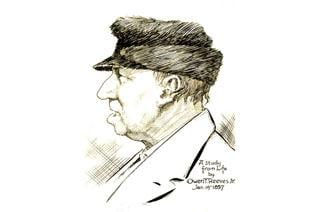
Despite his wealth, it was said that Brokaw lived with the "primitive simplicity of a Massachusetts Puritan." Others referred to him as the "millionaire in overalls." In his latter years he would walk to his workshop, always wearing the same sealskin cap (see accompanying image) and a worse-for-wear shawl.
Born in 1815 in New Jersey to French Huguenot and Dutch parentage, Brokaw came to Springfield in 1836 as a wheelwright apprentice. Once he gained his independence, he struck out for rustic, pre-railroad Bloomington, and it was there that he was said to have built the first wagon in McLean County.
People are also reading…
Around 1843, he purchased two lots at the corner of Center and Washington streets in downtown Bloomington and ran a wagon and plow shop from that location. According to one account, he paid $70 in cash and $55 in work for the two lots, which he later sold to People's Bank (now Commerce) for $25,000.
After the Civil War, Brokaw and a partner opened a much larger plow factory at the corner of Main and Market streets. At one time, the shop employed 30 men and turned out 2,500 plows a year. He never advertised and scoffed at the use of business letterhead. "The plows advertised themselves," he said.
Although Brokaw made a tidy sum in the plow business and Bloomington real estate, his real fortune lay in thousands of acres of McLean County farmland. For instance, he snapped up land warrants held by veterans of the Mexican War, buying 750 acres at 75 cents an acre. By the time of his death, this land was worth around $125 an acre.
In 1847 Brokaw married Eunice Ellsworth, and their residence in the 200 block of East Washington Street (where the Castle Theater now stands) was known as the "Puritan home." At a time when well-off families were using city gas for lighting, the Brokaws still kept kerosene lamps, and their wood-burning stove was considered a curio by younger visitors.
Exaggerations regarding his curmudgeonly ways were accepted as fact. For instance, it was widely believed that he kept track of his financial dealings by making notches on pine shingles or wood scraps from his workshop. On the contrary, he kept strict account of his finances through standard bookkeeping, though unlike many of his peers he kept his own books and rebuffed suggestions he hire a private secretary.
Though clearly not a big spender, Brokaw was hardly a miser. "By many who do not understand his character and disposition, he is considered coldhearted," said fellow businessman T.J. Bunn. "That is far from the truth." At the time of his death, he was said to have been "very liberal and accommodating" with hard luck debtors and tenant farmers.
In his final years, Brokaw's philanthropic efforts were directed at the new hospital located off Franklin and Virginia avenues in a rural stretch of south Normal. First known as Protestant Hospital and then Deaconess, Brokaw's financial assistance shepherded the institution through its early years. Through direct gifts, land trusts and eventually a share of his estate, Brokaw donated more than $200,000 to the hospital. In 1901, its name was changed to Brokaw. Bloomington's Mennonite Hospital merged with Brokaw in the early 1990s and today is known as BroMenn Regional Medical Center.
Abram Brokaw passed away on March 14, 1905, at the age of 89. At the time of his death, Brokaw's estate included some 6,000 acres of farmland worth around $750,000 and another $650,000 in personal property. He was worth an estimated $1.4 million, or more than $32 million today, adjusted for inflation.


