


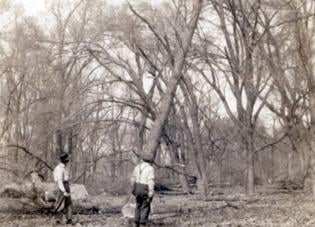
In the spring and early summer of 1929, in what ranks as one of the largest logging operations in McLean County history, "sawyers" from the North Woods felled 40,000 to 50,000 trees for the construction of Lake Bloomington.
Today, a boat ride on the lake takes one over what was once a wooded, serpentine valley on the Illinois prairie. The lake, situated about a dozen miles north of downtown Bloomington, was formed by the damming of Money Creek, a tributary of the Mackinaw River.
The lake markedly improved the quantity, quality and reliability of Bloomington's water supply. Before its completion, many Bloomington residents and businesses employed a dual water system, using the city's notoriously hard well water for drinking and bathing and softer water caught in cisterns for washing.
In 1920, a typhoid epidemic, centered at the Chicago & Alton Railroad shops, sparked community-wide support for a new water system. That same year, the city was hit with a drought, and some manufacturers had to close their doors due to a lack of water.
People are also reading…
This intolerable situation led to the formation of the Bloomington Water Co., a private corporation headed by local resident E.M. Evans. Funding came from the issuance of $1 million in bonds (or more than $12 million today, adjusted for inflation) financed by a group of Chicago bankers. The lake was a "turnkey" project in which the corporation, after completion of the lake, duly transferred ownership of the water supply to the city of Bloomington.
In March 1929, construction commenced on the "soft water reservoir." Eau Claire, Wis.-based Cast Stone Construction received the contract to clear the land, while the dam, spillway and pump house were built by the J.L. Simmons Co. of Bloomington.
Small rail line built
The project also required the construction of an 860-foot railroad siding, or switch track, off the Illinois Central several miles north of Hudson. From there, cement and other supplies were off-loaded from railcars and transported either by truck along a just-completed gravel road or by way of a temporary, 4.5-mile narrow-gauge rail line. Working the "industrial track" were several gasoline-powered "dinky" engines that could pull seven tons of freight.
Cast Stone Construction employed about 20 sawyers from Minnesota and Wisconsin, and about an equal number of local men for "grubbing" work. By April 1, there some 50 woodsmen engaged in clear-cutting the future lake bed and spillway. That number included 15 in the employ of John Clark, a Davenport, Iowa, subcontractor. These men concentrated on cutting and burning, leaving the marketable logs for the Cast Stone crews.
On the bottomland, lumbermen either burned or dragged away everything except the stumps, which were left to rot under the coming water. Trees were felled, the tops and smaller branches cut away, and the larger logs dragged to temporary sawmills, where they were trimmed into railroad ties, posts and mine props.
One of the most heavily timbered tracts was the J.S. Priest estate lands just south of the under-construction dam. By the end of April, the site's venerable oak and hickory trees were described by one contemporary as little more than "jackstraws" strewn upon the ground.
Blasting at spillway site
At the end of March, 500 pounds of dynamite were brought into the Cast Stone camp. On the spillway, the stumps were blasted out, since the soil from this area was needed for the construction of the dam. Overseeing the job was Adolph Lornson, a North Woods "powder monkey."
Interestingly, residents came to the rescue more than a few trees, making it likely that living remnants of the Money Creek bottomland survive today.
For instance, C.E. Hill, Bloomington parks custodian, spearheaded an effort to transplant 75 trees - including hackberries and burr, pin and white oaks - to Miller Park. Some area residents also dug up some of the valley's surviving wildflowers and replanted them back home.
By the summer, all that was left was a clear-cut gash in the green landscape. Yet less than one year later, on March 22, 1930, the first water from Lake Bloomington reached the city reservoir off Division Street. That day, hundreds of residents gathered at the city waterworks to be among the first to taste the new water.


