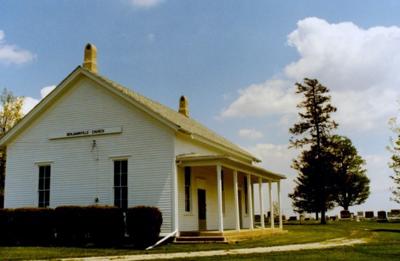


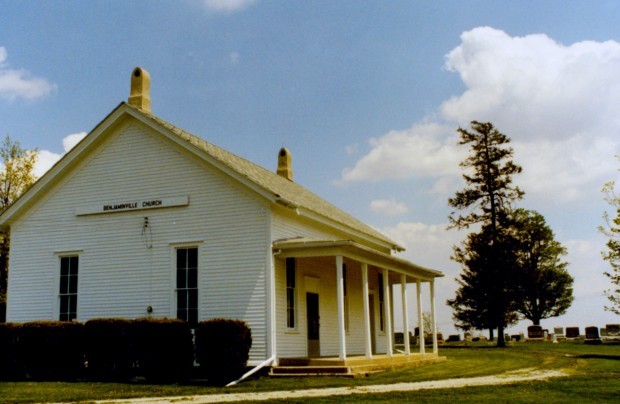
BLOOMINGTON — In the latter half of the 19th century, a small but vibrant community of Quaker wheat farmers thrived in east central McLean County. Although the Religious Society of Friends (hence Quakers also are called Friends) no longer has a presence in the area, its austere house of worship still stands, looking much like it did when it was built nearly 140 years ago.
This “meeting house” (the Quaker version of a church), located about 10 miles east of Bloomington, is the last 19th century survivor of the unincorporated hamlet of Benjaminville, now known as Bentown. The settlement derives its name from John R. Benjamin, a New York Quaker who came to McLean County with his wife Sarah and their two children in 1854. It was Benjamin who donated the roughly two acres for the meeting house and adjacent cemetery.
Benjamin settled on land situated on a slightly rolling morainal ridge running east from Bloomington. Though treeless, the elevated prairie was well-drained and thus well-suited for agriculture, especially wheat growing.
People are also reading…
Quakerism dates to the mid-17th century in England as a reform movement opposed to the perceived frivolities and excesses, doctrinal or otherwise, of the Church of England.
Once Benjamin had a toehold in McLean County, others of like-minded faith followed, and by the 1870s this rural stretch of Central Illinois boasted what was said to be one of the more successful Quaker communities in Illinois. In the great march westward, Quakers were advised to stick together by forming close-knit communities, lest their unadorned, sober-minded faith — and that of their impressionable children — be undermined by non-Friends. Quaker families settling in the Benjaminville “neighborhood” included the Bedells, Clements, Hamiltons, Marots, Moores and Rays.
More than 100 years ago, local Quaker matriarch Elizabeth Coale declared the Benjaminville Friends stood for equal rights for men and women, peace and arbitration, prison reform, temperance, Native American rights and the promotion of education, and against things like lotteries, gambling and prizefighting.
The first meeting house went up in 1859, though as the local community continued to grow and mature, a more substantial meeting house was built in 1874. Measuring a cozy 42-by-32 feet, this still-standing wood frame building speaks to the Quaker principle of well-balanced simplicity.
The south side of the building includes an 8-foot-wide porch and two entrances, one for men, the other for women. That symmetry is retained inside with the meeting room bisected by a low wall. Normally, Quakers placed movable shutters atop the dividing wall to allow separate meetings for men and women. Yet this meeting house was said to be one of the first in North America to have an open partition so the sexes could worship together.
The cemetery also is divided into sections — one for Quakers and one for non-Quakers, with the burials, like the meeting house and the pews within, running east-west.
Benjaminville once included two other churches, a store, blacksmith shop and several residences. The town’s fate was sealed in 1870 when what would become the Lake Erie & Western Railroad decided to lay its east-west line about a mile to the south. In the immediate area, the LE&W gave rise to the new communities of Holder, Padua, Ellsworth and Arrowsmith, while it led to the demise of several pre-railroad pioneer settlements, not only Benjaminville, but also Fairtown, Senix and Stumptown.
Some of Benjaminville’s structures were placed on skids and moved to one of the new depot and grain elevator towns. For a while at least, the hamlet’s decline didn’t adversely impact Quaker life, since most Friends were farmers and not shopkeepers or townsfolk. Yet in the end, this community proved too small to be self-sustaining, given the passing of the stout pioneer generation, as well as the increase in mixed (denominationally speaking) marriages and the inevitable removal of Friends to other locales.
Today, the old meeting house looks much like it did when it first opened its doors. The few obvious changes include a concrete floor for the porch and, sometime around 1910, the erection of an attached storage shed with two privies.
In 1983, the Benjaminville Friends Meeting House and Burial Grounds (as it’s formally known) was placed on the National Register of Historic Places. For many years now the Benjaminville Cemetery Association has served as caretaker for the site, and though it no longer serves as home to regularly scheduled Quaker meetings, it remains one of the lovelier and more peaceful spots in all McLean County.