


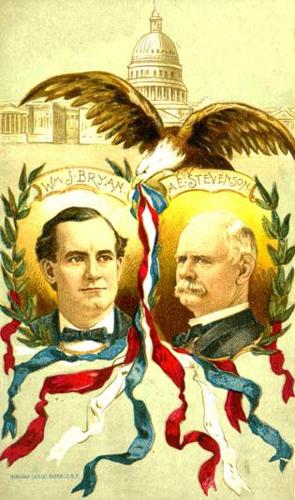
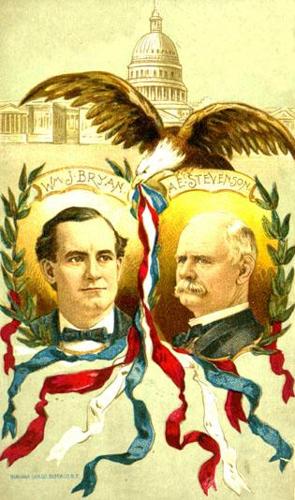
In 1900, for the second time in eight years, Bloomington's own Adlai E. Stevenson I was the Democratic Party's candidate for vice president.
The Nov. 6, 1900 election matched Democrat William Jennings Bryan and Stevenson against Republican incumbent William McKinley and his running mate Theodore Roosevelt. Stevenson was in his hometown on election day, and the trappings of turn-of-the-century campaigns - the torchlight parades, neighborhood and political clubs, protracted speechifying, and the constant buzz of saloon and sidewalk politicking - made for a shared, participatory experience wholly lacking in today's presidential contests.
Stevenson, a lifelong Democrat in Republican McLean County, was Grover Cleveland's running mate when the Democrats captured the White House in 1892. After spending four years in Washington, D.C., Bloomington's favorite son returned home only to be called back onto the national stage four years later.
People are also reading…
For McKinley and Bryan, the 1900 election was a rematch of their epic 1896 clash that pitted the "full dinner pail" GOP against the populist-inspired platform of the Democrats. The first go-around was a one-issue campaign waged between hard money "goldbug" Republicans and "silverite" Democrats who favored devaluation through the unlimited coinage of silver. Although the currency question did not entirely disappear in 1900, other issues, namely empire aboard and monopolies at home, dominated the campaign.
The Democrats called for the U.S. government to rid itself of colonial possessions gained from the Spanish-American War. In the Philippines, America found itself entangled in an ugly guerrilla war known as the Filipino Insurrection (today called the Philippine-American War). The Bryan-Stevenson ticket also assailed Republicans for failing to breakup large business combinations known as trusts.
Before the arrival of television (to say nothing of 24-7 cable news, Web sites, and now blogging and YouTube), political participation was a far more communal affair.
For example, on the Friday before the election, Chenoa Republicans staged a rally in their fair community, welcoming delegations from Eureka, Pontiac, Washington and elsewhere. "The evening parade surpassed anything of the kind ever held in Chenoa, fully 1,200 people being in line," reported The Pantagraph. "It was a pretty sight, fireworks were used galore and the city was a perfect blaze of rockets, torches and red fire."
The night before the election, Bloomington was the site for an even larger GOP rally. A parade to the Grand Opera House included the DeMolay Band; a "first voters" club; a "colored" (African-American) club replete with white suits and blue lanterns; a boys' drum corps; and a line of "un-uniformed marchers" stretching several blocks.
The Democrats staged equally raucous events, climaxing with a parade and rally at the old Coliseum in downtown Bloomington. Stevenson spoke for a full hour, spending most of his time on the question of imperialism and the Philippine-American War.
Later that evening, partisans from both sides filled the streets of downtown Bloomington. "The rancors of the campaign were forgotten, and everybody got jolly," noted The Pantagraph.
Before radio, newspapers had ingenious methods to deliver breaking news. On this election night, for instance, the Pantagraph used a stereoptican machine to project up-to-date vote totals onto a large canvas hung on a building across Madison Street.
The newspaper reached an even larger audience via signal rockets. On the morning of election day, readers were told that at 11 p.m. the newspaper would fire off one flare in the event of a Bryan victory, and two for McKinley. And for those within hearing distance, "cannon rockets" would go off around the same time - one boom for the Democratic standard-bearer and two for the Republican.
In the end, McKinley captured Illinois en route to a decisive victory over Bryan, outpacing his opponent 292 to 155 in the Electoral College and 51.6 to 45.5 percent in the popular vote. (A handful of third party candidates accounted for the remainder). In McLean County, McKinley garnered 9,487 votes to Bryan's 6,613.
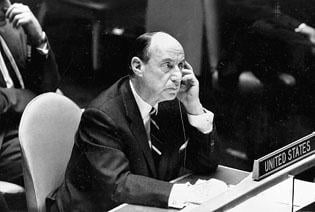
In 1908, Stevenson ran for governor, narrowly losing to incumbent Republican Charles S. Deneen. The patriarch of McLean County Democrats passed away in 1914 and is buried at Evergreen Memorial Cemetery on Bloomington's south side. The family plot also includes the grave of his grandson, Adlai E. Stevenson II, who was a one-term Illinois governor, twice the Democratic nominee for president, and U.S. ambassador to the United Nations.
The home of Adlai Stevenson I is located at the corner of McLean and Chestnut streets off Franklin Park.


