


It was the miracle pesticide of the age, sprayed on everything imaginable, from crops, livestock and pets to screen windows, mattresses and blankets.
After World War II, the Corn Belt embraced the chemical known as DDT, and for the better part of the next two decades, its use was both widespread and unchallenged.
Today, we look upon the indiscriminate use of chemicals with a jaundiced eye. Such was not the case in the mid-20th century.
In 1939, Swiss chemist Paul Hermann Muller synthesized a chlorinated hydrocarbon known by its abbreviated name DDT, and it proved effective in killing houseflies, the Colorado potato beetle, and even lice carried by World War II refugees. The U.S. military used DDT to control malaria in the Pacific Theater and typhoid outbreaks in Europe, most spectacularly in Naples, Italy.
DDT was trumpeted as one of the greatest discoveries of the 20th century. At the war's end, the U.S. government approved its unrestricted use, and it became, according to one authority on the history of DDT, "by far the most widely and heavily used chemical pesticide through the 1950s."
People are also reading…
Introduced here just after war
Locally, the pesticide hit the market Sept. 5, 1945, less than a month after the surrender of Japan. The Pantagraph noted that a DDT-treated blanket could be washed five or six times and still kill moths, and that mattresses sprayed once with the stuff could kill bedbugs over a nine-month period.
In 1947, a number of McLean County farmers participated in DDT trials, including O.L. DeVore, who worked on the Lexington-area stock farm of Almo Franklin.
"We dusted our corn with DDT, by airplane, to protect it from borers," he said. "Some of the DDT dust drifted from the nearby cornfield over around the house and lawn. The protection was so good that Mr. Franklin commented that screens may not be needed when we form the habit of using DDT regularly to control insects."
Yet even during the early, heady days of the DDT craze, there were warnings.
In September 1945, G.C. Decker, entomologist with the Illinois Natural History Survey, cautioned against the "promiscuous use" of the pesticide. He noted that it killed indiscriminately, and thus posed a danger to beneficial insects such as pollinating bees. It also proved to be highly toxic to cold-blooded animals, such as fish and snakes, as well as some mammals, like cats.
Demonstrations around county
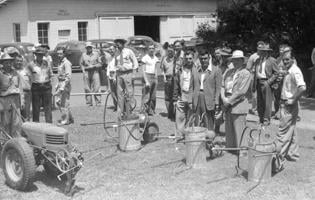
In late May 1948, McLean County Farm Adviser Eugene Mosbacher organized seven DDT spraying demonstrations, including one at the Illinois State Normal University farm, located where Hancock Field stands today. Other demonstration sites included Dewey Varboncouer's farm three miles north of LeRoy, and Otto Schaefer's home on the George Parker farm northeast of Saybrook.
Mosbacher's demonstration coincided with a McLean County fly control campaign. W.J. Broad of the McLean County Health Department explained that flies helped spread typhoid, infantile paralysis (polio) and dysentery. Urban and rural residents alike were asked to spray all fly breeding areas, such as garbage cans and outhouses, with DDT.
At this time, DDT-related advertisements filled the farm pages of The Pantagraph. "The corn borer may or may not be with us this year! However, we have 300 tons of DDT dust ready," read a Miller Hatchery and Farm Store advertisement. The business sold an array of DDT products, such as DuPont 50 percent DDT for dairy barns and other outbuildings, and C.C.C. Powder with 10 percent DDT to kill roaches, ants, fleas, bedbugs and lice.
Biological effects
Over time - given the misuse and abuse of DDT - insect populations began developing increased resistance. Even more ominous was the "biological magnification" of DDT as it worked its way up the food chain.
Most infamously, this wrought havoc with the reproductive cycles of certain bird species, primarily through the thinning of eggshells. DDT, it was learned, was the primary culprit in the rapid decline of the bald eagle, peregrine falcon, osprey and others, as well as the near-extinction of the California condor.
In 1962, nature writer Rachel Carson's book, "Silent Spring," detailed the impact of DDT on the environment. Today, its publication is regarded as a seminal event in the emergence of the environmental movement.
On Jan. 1, 1970, the state of Illinois halted the sale and use of DDT, and three years later, the federal government banned most domestic uses of what was once known as the miracle pesticide.
Today, DDT is still used to control malaria in sub-Saharan Africa and other poor corners of the globe. It remains controversial, though, with certain public health officials advocating its increased use, while environmentalists call for what they believe is a long-overdue global ban.


