


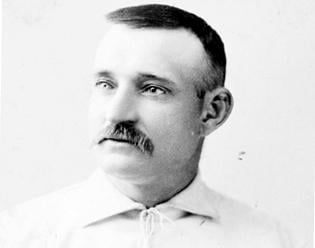
In 1884, right-handed twirler Charles "Old Hoss" Radbourn of Bloomington set a record for wins in a big-league baseball season.
Today, 124 years later, it's inconceivable that any pitcher will top Radbourn's stunning single-season mark of 60 victories.
Born in Rochester, N.Y., in December 1854, Radbourn (also spelled Radbourne with an "e") moved to Bloomington with his family at a very young age.
He learned the game in club-level matches between local "nines" and those from nearby communities.
He also played for Illinois Wesleyan University at a time when local "ringers" rounded out college lineups.
Baseball during Radbourn's early career was a rough-and-tumble enterprise.
For instance, in September 1876, the future hall-of-famer found himself implicated in a fixed game involving Bloomington's semi-pro club.
People are also reading…
The Pantagraph accused three gamblers of "sugaring" several Bloomington players into throwing a game against the visiting Springfield nine.
The night before the "dirty swindle," Radbourn, who admitted to being a little "off his foot," met two of the fixers at Schausten's, a downtown salon.
The Pantagraph described the incident this way: "[Radbourn] does not deny that he may have said that he would take the money, but, being drunk, was not responsible for his words."
He played minor league ball in Peoria and elsewhere, and in 1881 began his major league career with the Providence (Rhode Island) Grays of the National League.
"Radbourn pitched with his head as much as with his right arm," remembered Providence Manager Frank "Banny" Bancroft.
Old Hoss, who "knew the weaknesses of every batter in the league," was a master at tweaking his delivery to change the angle and speed of the ball as it approached the plate.
During his 11 seasons on the mound, he won 310 games (or maybe 309 - baseball historians can't agree).
Regardless, his reputation rests with his record-breaking 1884 season with Providence.
The story goes that when Charlie Sweeney, the Grays other ace, left over a petty disagreement with management, Radbourn agreed to pitch every game in exchange for the remainder of his former teammate's contract.
Radbourn completed all 73 of his starts that season, winning 60 (or 59 according to other sources - 19th century accounts of ball games can be thin gruel for stickler statisticians) over a staggering 650-plus innings of work.
Bancroft, the Providence manager, later said that Radbourn was the "only one-man team in the history of the game."
Today, 20-game winners are increasingly rare, and it's been 40 years since a big league pitcher won 30 or more games in a season.
Detroit's Denny McLain went 31-6 in 1968.
Not surprisingly, Radbourn's throwing arm was never the same after the epic 1884 campaign.
He pitched one more season for Providence before the dissolution of the franchise, and then spent four solid but hardly spectacular years with the Boston Beaneaters.
Saddled with a "glass" arm, he wrapped up his career with the Boston Reds of the short-lived Players League, and then one final hurrah in the National League, this time with Cincinnati.
Nineteenth-century baseball offers little solace for those who pine for the days when grown men played for the love of the game.
In Old Hoss' era, cold hard cash was as much a part of the game as brawling, hard liquor and gambling.
Owners were ruthless and players, though still under contract, would often "jump" to other teams or "outlaw" leagues like the labor-led "Brotherhood."
In 1886, Radbourn earned a then-record $4,500 (or more than $103,000 today, adjusted for inflation).
A year later, a worn-down "Rad" returned to Bloomington for some off-season R&R.
"He is heartily tired of the slavery under the present arbitrary league contracts, where men are bought and sold like cattle," noted the sympathetic Pantagraph.
After leaving baseball, Old Hoss spent much of his time fishing and hunting, while keeping an occasional eye
on his billiards saloon at 214
W. Washington St. "Best of Everything in Wet Goods
and Cigars" read an 1891 advertisement for "Radbourn's Place."
During retirement, he lost an eye in a hunting accident, and suffered from other whispered maladies.
Radbourn, according to one account, "grew sick, lingered on from year to year as disease gnawed at his mental and physical being, robbing him of speech, feeling and locomotion long before the final day arrived."
Radbourn's final day came on Feb. 5, 1897.
He was 42 years old. Induction into the National Baseball Hall of Fame came posthumously, in 1939.


