


Invasive species can wreak havoc on native species and cause major economic harm in their colonized environments. Illinois State University undergraduate student Jadyn Golz is using advanced DNA techniques to investigate how scientists can detect two intruders before their populations explode in new areas.
Golz, a senior biology major and environmental health and sustainability minor from Addison, received a $3,000 FIREbird (Faculty-mentored Independent Research Experiences) grant this summer from the Office of Student Research for her study, Investigating environmental DNA (eDNA) shedding and decay rates across species and conditions, under the mentorship of Assistant Professor of Ecology of Human-Impacted Systems Kara Andres.
People are also reading…
Golz is focusing on the zebra mussel, a shelled invertebrate, and the round goby, a small bottom-dwelling fish, both native to the Black and Caspian seas. They arrived in the Great Lakes in the 1990s, brought over in the ballast water of European cargo ships. These freshwater animals have since expanded to the Illinois and Mississippi rivers and other Midwest and Northeast waterways, causing millions of dollars in damage to water treatment plants and harming native species.
Like other invasive species, zebra mussels and round gobies thrive because they can tolerate a wide range of environments and lack native predators and competitors in their invaded waters.
“They’re incredibly effective at reproducing, moving around, and living in a wide variety of conditions,” Dr. Andres said. “It’s presumed that they can persist in tributaries of the Illinois River, such as the Mackinaw River and Sangamon River, and it may just be a matter of time before they invade these systems as well.”
Despite their abundance, neither species is easy to find nor trap since they inhabit the largely inaccessible sections of big lakes and rivers, Golz said. Early detection is key to preventing the proliferation of invasive species, and eDNA offers an avenue to locate them before they become entrenched in new waterways.
“Environmental DNA approaches rely on detecting the DNA that organisms are releasing into their environment, and by sampling a little bit of water, we can detect what species are there and understand something about the biological community,” Andres said.
This is Golz’s first independent study, but she gained her initial exposure to research as a sophomore in the School of Biological Sciences’ Rainforest Ecology course. During the class’s fall break trip, she conducted a hands-on study of leafcutter ants at La Selva Biological Station in Costa Rica.
“That really got me into ‘this is what science is,’” Golz said. “This is how you design an experiment beyond what you do in a teaching laboratory with a guided worksheet.”
Last fall, Golz joined Andres’ lab, where, under the professor’s mentorship and by collaborating with more experienced lab mates, she began formulating the parameters and learning the lab techniques for her current investigation. The FIREbird grant has allowed Golz to dedicate her time to research and buy equipment she is using in these experiments. The goal of her study is to understand how different species and conditions affect scientists’ ability to detect their eDNA in freshwater.
Like a forensic scientist investigates a crime scene for evidence left by perpetrators, biologists hunt for genetic traces cast off by aquatic animals.
“We’re going to investigate how DNA sheds and how it decays. Those rates vary depending on two variables: temperature and taxa,” Golz said. “You might assume that in colder temperatures the DNA is going to stay around longer; in warmer temperatures it’s going to degrade faster. We are also comparing two species: the zebra mussel, which we are working on this summer, and the round goby, which we will be testing in early fall.”
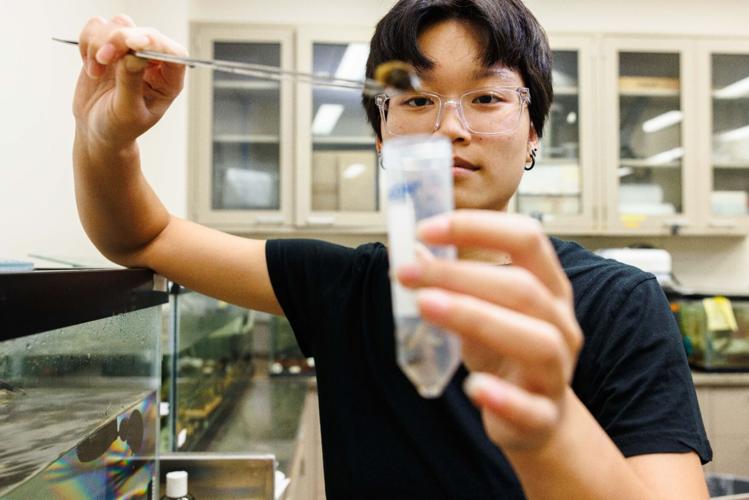
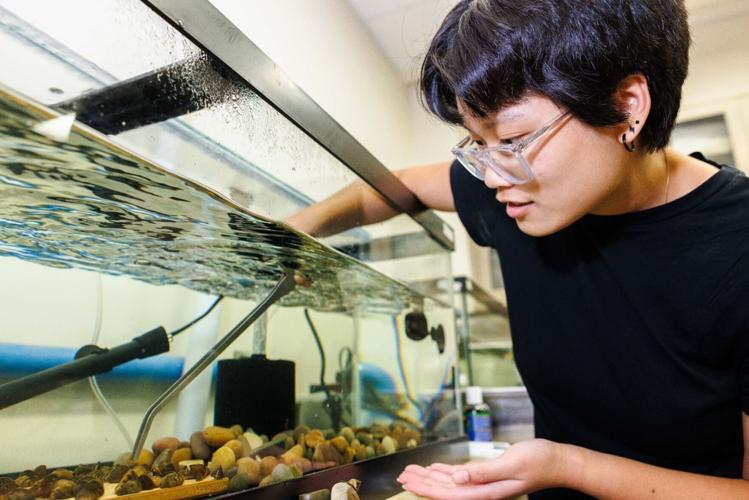
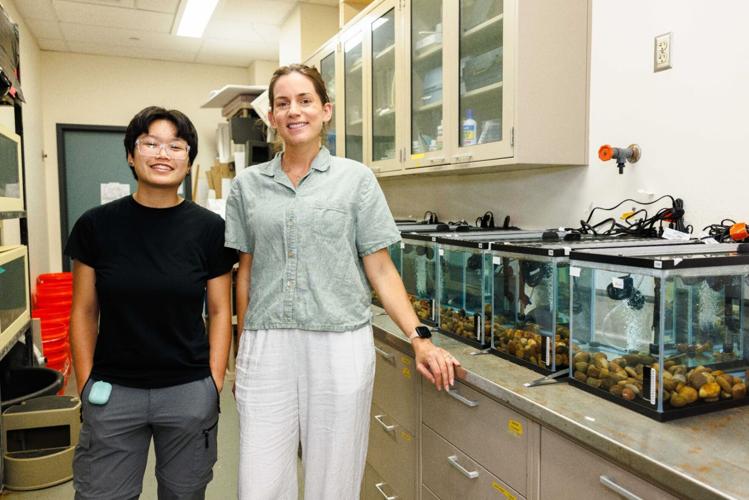
For the experiments, the animals are placed in water tanks in Andres’ laboratory, where the researchers can control environmental factors such as water conditions, movement, and volume. “Through these controlled conditions, we’ll be able to make our shed and decay calculations across time,” Golz said.
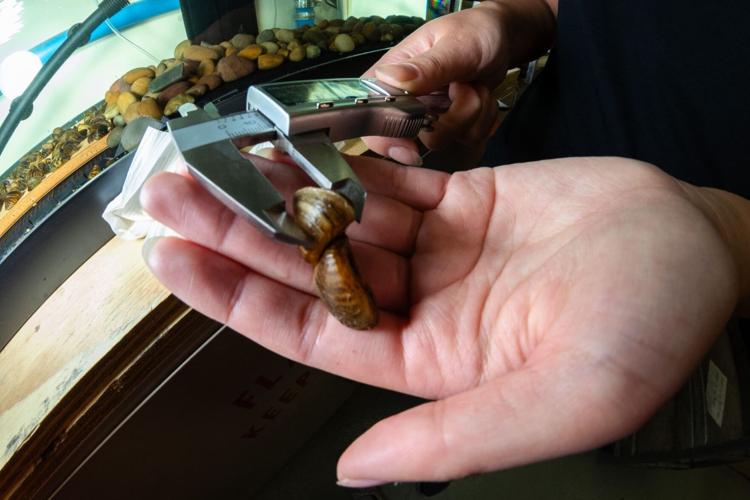
One aspect of Golz’s study that separates it from previous eDNA research is her focus on mussels, not only fish. Golz is investigating whether the eDNA of the zebra mussels behaves in the same way as fish and, a more active, larger study taxa. The zebra mussel is immobile, and its soft tissue is encased in a shell. Round gobies, like other fish, are mobile, and their flesh is fully exposed to the water.
“We’ll be taking periodic eDNA samples from the tank, and then, we’re going to remove the organisms and continue taking samples afterwards,” Golz said. “What we’re hoping for is a graph that shows the change in DNA concentration across time. Initially, we expect zero DNA in the tank prior to introduction. After the zebra mussels are placed in the tanks, we expect the DNA concentration to increase. Eventually, the DNA concentration will level off in a period we call ‘steady state,’ where the rate of DNA shedding equals the rate of DNA decaying. Finally, after removal of the mussels, we expect the DNA concentration to return to zero.”
Golz will replicate the experiments using round gobies later this fall before wrapping up the research over the winter. She plans to present a poster on her findings at next spring’s University Research Symposium and work toward a publication.
“This grant has really given Jadyn the opportunity to grow as a scientist,” Andres said. “Not all institutions have such large grants available to undergrads, and this has allowed her to develop an independent research project that she can focus on for the entire summer. This experience will really help her stand out on her graduate school applications and is a great opportunity for undergraduate students to hone their research skills.”
Golz said the research and grant-seeking process have helped prepare her for graduate school, where she hopes to pursue a doctorate and continue her research into freshwater invertebrates. “It’s been a great learning curve, and it’s been really exciting. Even through the frustrations and the confusion, it’s been really fun.”


