


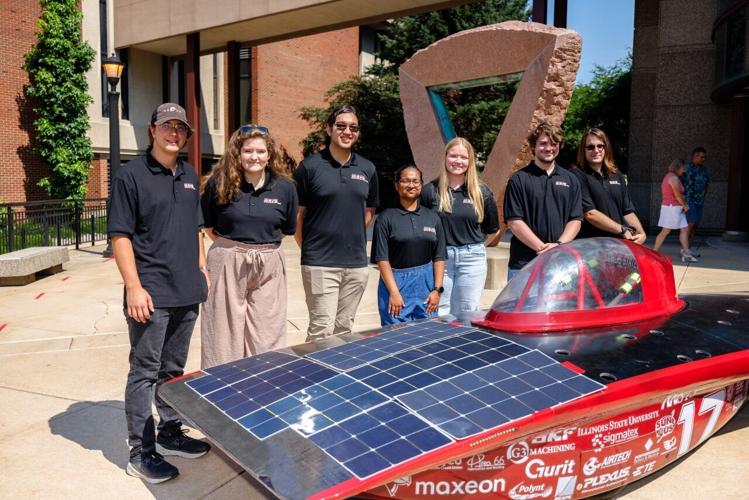
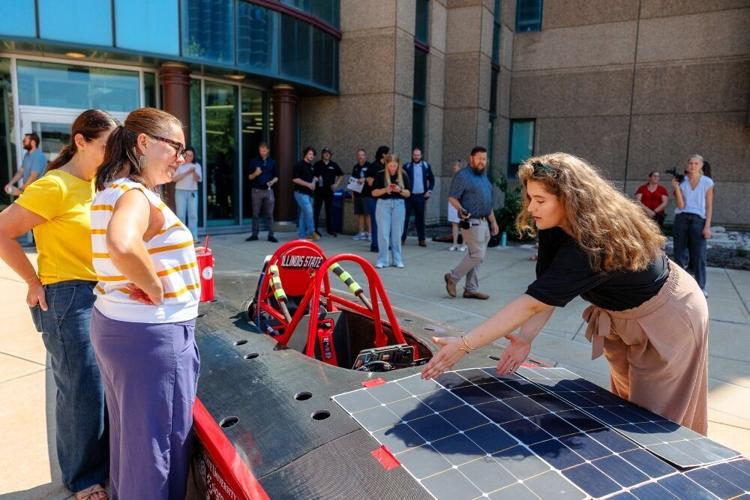
Under a cloudless sky—ideal conditions for a car powered by sunlight—the Illinois State University Solar Car Team rolled out their newest design, the Mercury 8 solar car, to a crowd of local residents, media, family, and faculty on Tuesday, July 14.
The Bloomington-Normal and Redbird communities came out to show their support in front of the Science Laboratory Building as the team faces the annual Electrek American Solar Challenge. This year, the challenge will pass through McLean County, with qualifying heats starting July 21 in Brainerd, Minnesota.
“The car is ready and the team is excited,” said Dr. Ivan Medvedev, Department of Physics chair and a faculty advisor for the Solar Car Team. “We’re hoping to place well like we did in 2024.”
In 2024, Illinois State placed third among 14 competing colleges and universities from around the country.
People are also reading…
The team will first travel to Brainerd International Raceway to compete in the Formula Sun Grand Prix on July 21. Teams that qualify will advance to the main challenge starting July 25: a 1,500-mile drive across the heart of America.
At 465 pounds, the Mercury 8 takes the mass of an average motorcycle and spreads it across a lightweight chassis holding an array of solar panels and a high-capacity battery-powered electrical system.
“A lot of the challenge in making the car is the weight,” said the team’s mechanical lead, Mac Brody, a senior studying mechanical engineering. “Everything has to be within certain specs,” according to the competition’s rules.
All cars in the competition are road-legal, crash tested, and are subject to days of scrutineering by competition organizers to ensure the cars can complete the challenge safely.
But it isn’t just an endurance challenge for the cars.
“From nine in the morning to five at night” the team will take shifts driving, Brody said. “Our goal is to make sure that we can stay on the track and be driving for as long as possible.”
“Our goal is to make sure that we can stay on the track and be driving for as long as possible.”
—Mac Brody
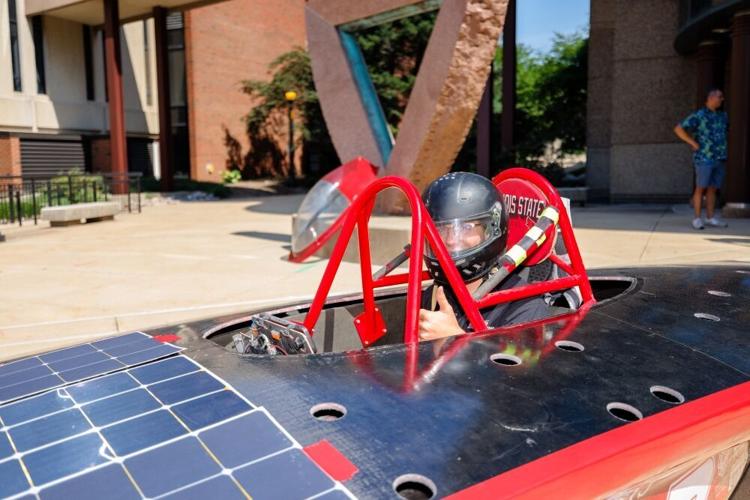
Driving in the American Solar Car Challenge isn’t as comfortable as your average cross-country road trip. For one, the driver is seated in a roll cage cockpit just big enough to hold them under a clear plastic canopy. For another, the Mercury 8 has no air-conditioning.
“We have to have driver ventilation in the car,” said Shane Burke ‘26, a computer science graduate. “It’s not like full-blast AC, but it can get air moving.”
Burke was perhaps being modest about the challenge he faces as one of the car’s four drivers. The team has measured the temperature in the cockpit as being, on average, 15 degrees hotter than the air outside when driving in the summer sunlight the car relies on. As of July 15, the forecasted high in Brainerd on the first day of the qualifying heat is 75 degrees.
“Some people get into this because they’re really interested in electrical systems. Some people get in there because we just want to turn a wrench. And then other people, they really want to be out there and be driving. All of us do everything on the car. People specialize, sure, but we all learn everything about it,” Brody said.
In celebration of the 100th anniversary of Route 66, the American Solar Challenge will travel from Minnesota southeast through Illinois to connect with the Mother Road, then continue southwest to its ultimate destination in Amarillo, Texas.
Between July 26 and 27, the cars are expected to pass through Normal as one of the checkpoints in the first stage of the challenge. While there’s no telling when the teams might come through campus, lucky spectators might catch them cruising down Adelaide Street and Delaine Drive, past Wright Hall and Haynie Hall.
A complete route, including the optional loops, is available at the American Solar Challenge (ASC) website, and fans will be able to track teams’ progress in the event via ASC’s official social media accounts, in addition to coverage from Illinois State University, College of Arts and Sciences, and Solar Car Team social accounts.


