


From a legendary campus performance by the “Queen of Soul” to the lasting poetry of Richard Hovey, Tom Emery explores this month in Illinois State University history.
October 9—Former Redbird receiver makes the most of NFL career with Chicago Bears
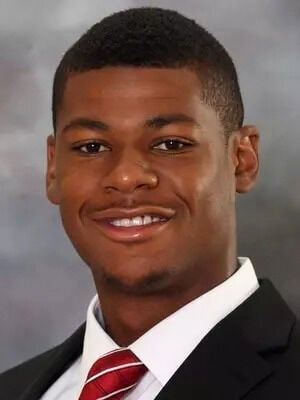
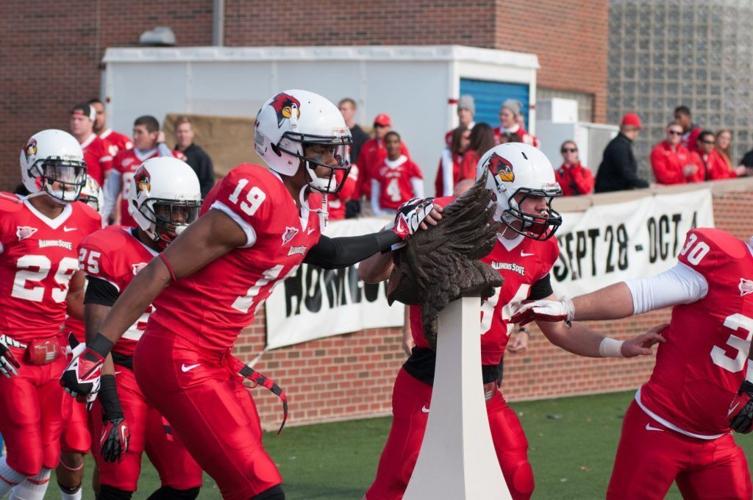
On this date in 2016, Cameron Meredith ’15 earned his first start with the National Football League as a receiver for the Chicago Bears, the beginning of a promising career cut short by severe injuries.
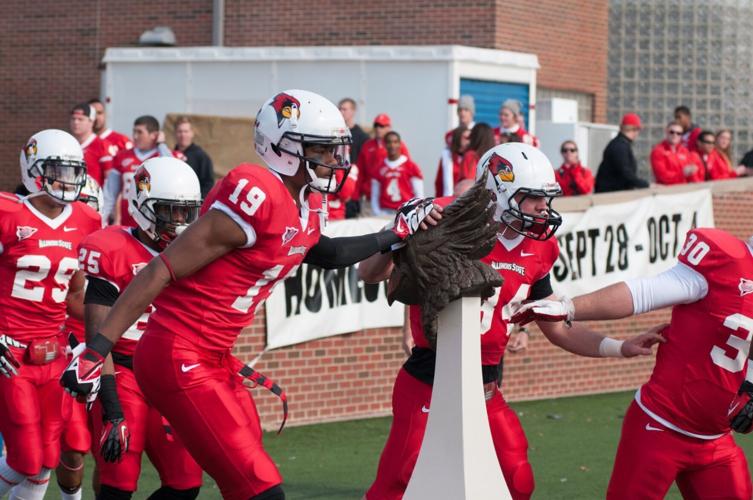
In Normal, Meredith is best remembered for his stellar 2014 season, when he led Illinois State with 66 receptions for 1,061 yards and nine touchdowns as the Redbirds advanced to the Football Championship Subdivision national title game.
He seemed to overcome all odds just to reach the NFL. A quarterback at St. Joseph High School in Westchester, he played for a program that endured five consecutive winless seasons from 2003-07, a streak of 45 games. St. Joseph was a combined 3-15 in his junior and senior seasons.
People are also reading…
At Illinois State, the 6-foot-3, 207-pound Meredith redshirted as a freshman quarterback in 2010, then sat on the bench for virtually all of the next two seasons. During the bye week before the 2012 playoffs, head coach Brock Spack suggested moving Meredith to wide receiver. It proved to be a wise decision, as Meredith produced solid numbers in 2013 and a breakout 2014 season.
Despite just a couple of years of experience as a receiver, Meredith signed with the Bears as an undrafted free agent in 2015 and earned a spot on Chicago’s roster after a strong preseason. As a rookie, he recorded his first NFL reception on September 20, 2015, in a loss to Arizona. He played in 11 games with 120 receiving yards and 11 catches.
In 2016, Meredith climbed up the depth chart due to injuries in the Chicago receiving corps and made the most of it. After being inactive in the first two games, he made his season debut in Week 3 in a 31-17 loss at Dallas and, as usual, kept getting better.
Two weeks later at Indianapolis, he made his first NFL start, catching nine passes for 130 yards as the Bears lost 29-23. He picked up his first NFL touchdown on a 14-yard reception in the same game. It was the first of four 100-yard receiving games for Meredith on the year. In the season finale at Minnesota, he tossed a 2-yard touchdown pass off a trick play, his first NFL passing score.
Though Chicago finished 3-13 in 2016, Meredith was one of the bright spots as he led the Bears with 66 receptions and 888 receiving yards, with four touchdowns. That lifted Meredith to the top of Chicago’s depth chart heading into the 2017 season but, sadly, it did not last long. In the Bears’ third preseason game, he suffered devastating injuries, including a torn ACL, and missed the entire season.
Meredith signed with New Orleans before the 2018 campaign, appearing in six games with one start and one touchdown before being placed on injured reserve in November. Injuries also derailed opportunities with New England in the 2019 preseason and with Winnipeg of the Canadian Football League in the summer of 2021.
October 12—Aretha Franklin appearance tops list of Illinois State’s best concerts
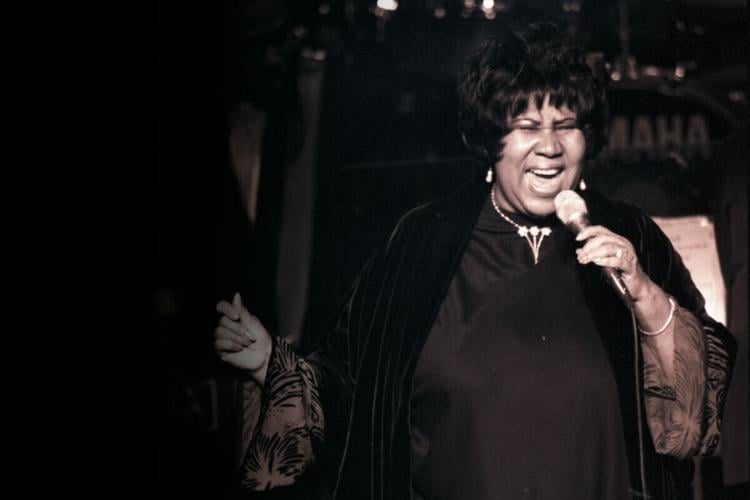
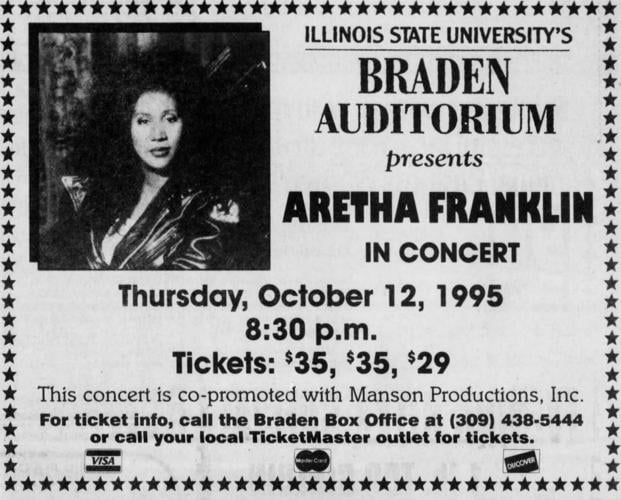
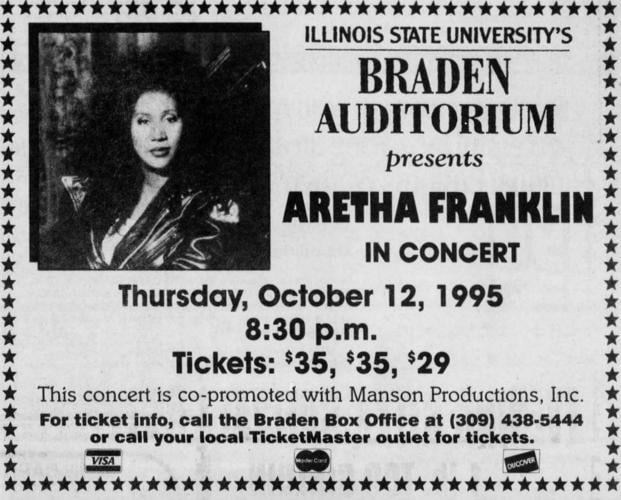
On this date in 1995, Aretha Franklin, the “Queen of Soul” and one of the most popular performers in American music history, appeared at Braden Auditorium during Parents Weekend at Illinois State.
In her brilliant career, Franklin sold over 75 million records and placed 112 singles on the U.S. Billboard charts, including 20 that hit No. 1 on the R&B charts. Her best-known hits include “Respect,” “(You Make Me Feel Like) A Natural Woman,” “Chain of Fools,” “Think,” and “Freeway of Love.”
Franklin, who died at 76 in August 2018, won 18 of her 44 Grammy nominations, including the first eight Grammys ever given for Best Female R&B Vocal Performance, from 1968-75.
In 1987, eight years before she performed at Illinois State, Franklin became the first woman inducted into the Rock and Roll Hall of Fame. She later received the Grammy Living Legend Award (1991), the National Medal of Arts (1999), and the Presidential Medal of Freedom (2005).
In 2023, State magazine published a list of the 50 top concerts of the past half-century at Illinois State. Franklin’s 1995 appearance was No. 1 on the list.
Prior to the concert, an overflow crowd created long lines in the Braden lobby. The intermission between the opening act—Lenny Williams of Tower of Power—and Franklin ran an extra 15 minutes, and the crowd clapped for an extended time to call her to the stage.
The Vidette wrote that “the crowd rose with roaring applause as she took the stage” for her first song, “Can’t Turn You Loose.” After “Ain’t Nothing Like the Real Thing” and “Think,” The Vidette reported that “Franklin was surprised with the enormous response from the audience and moved onto ‘Respect.’” The paper continued, “the entire audience stood up, rocked with the music, clapped their hands, and yelled out ‘R-E-S-P-E-C-T.’”
After another intermission, Franklin, in the words of The Pantagraph, “returned to perform a majestic version of The Beatles’ ‘Long and Winding Road.’” She then promised to “do something for all the romantics and lovers in the house,” sitting at the grand piano to belt out “You Send Me” and “Bridge Over Troubled Water.” The show concluded with “Sometimes it Hurts to Love So Bad” and “Move the Spirit.”
The Vidette had a minor complaint: “the audience seemed impressed with Franklin’s style and pizzazz,” but “much to their disappointment,” she “only performed for 55 minutes.”
It may have been a short concert, but it made its mark. The Pantagraph concluded that “frankly, she’s still (the) queen.” Over three decades later, no one at Illinois State disagrees.
October 13—Remembering Mary Hartmann, a pioneering woman on Illinois State faculty
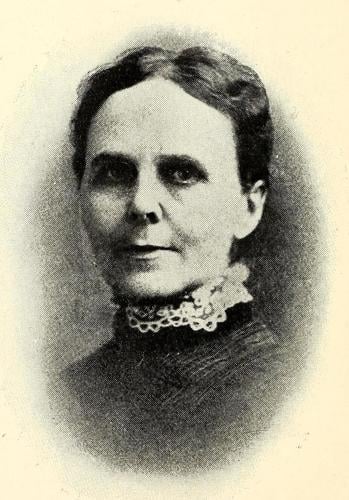
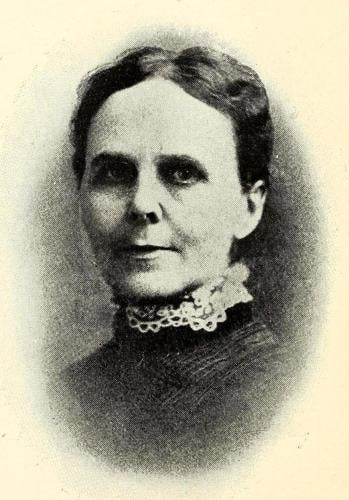
On this date in 1845, Mary Hartmann, one of Illinois State University’s earlier female faculty members, was born. Hartmann was a mathematics professor at Illinois State from 1882-1909 and one of the most respected individuals on campus during much of her time in Normal.
Born in Indiana, Hartmann grew up on a farm near Fairfield, Iowa, and graduated from Lombard College in 1869. She taught high school in Galva and Freeport, was principal of the high school in Tuscola from 1874-75, then taught in Marshalltown, Iowa, from 1876-81, serving as principal for the last four years.
After a stint as an instructor in mathematics and Latin at present-day Winona State University in Minnesota, she accepted a teaching position at Illinois State in 1882. While teaching in Normal, she earned a master’s degree from Lombard in 1888.
During her early years at the University, the campus grew substantially. In February 1888, The Vidette wrote, “Miss Hartmann has to bring in chairs to accommodate the members of her immense algebra class.”
Like most teachers, Hartmann was not in it for the money. When The Vidette listed faculty salaries on July 12, 1907, Hartmann—who had taught at Illinois State for a quarter-century—was scheduled to earn $1,200, the equivalent of less than $44,000 today.
Still, Hartmann exhibited great dedication to her work. The Pantagraph praised her as a “competent, faithful, (and) painstaking” individual who was “calm and unruffled under many trying situations.”
Active on campus well into retirement, Hartmann co-directed the school’s first Glee Club, served on the current events committee, and was involved in the Sapphonian Society. In the community, Hartmann was active in her church, the Bloomington Woman’s Club, the Normal Improvement League, the American Red Cross, and the Florence Fifer Bohrer Club—a politically themed women’s group that supported Bohrer, a Bloomington resident who was the first female state senator in Illinois history.
In fall 1928, she was seriously injured when she was struck by a car. Hartmann was ill for several weeks before her death on December 16, 1932. Two days later, The Pantagraph remembered her as “one of the outstanding figures in the faculty of the ‘old’ Normal university,” noting her “kindly face was a benediction to all.”
October 15—Poet Richard Hovey, son of university’s first president, leaves lasting legacy
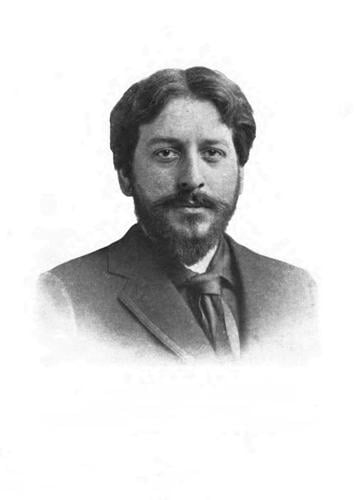
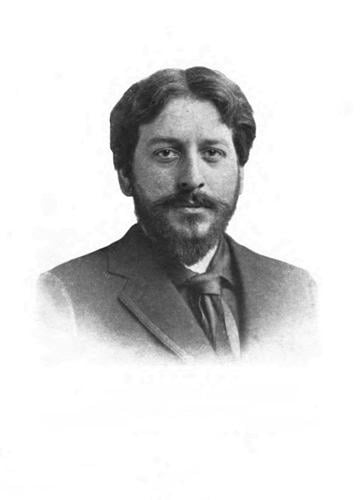
Today is National Poetry Day, a time to honor the art of poetry. A number of acclaimed poets have Illinois State University ties, including Richard Hovey, son of the University’s first president, Charles Hovey.
The younger Hovey became one of the nation’s foremost poets before his death at 35 in 1900. He is best remembered for writing “Men of Dartmouth,” the alma mater of Dartmouth College, where he studied as an undergraduate.
Hovey was born May 4, 1864, in the family home at 202 West Mulberry Street in Normal, shortly after his father resigned his commission with the 33rd Illinois Infantry during the Civil War. By 1866, the family was living in Washington, D.C., where his father practiced law and his mother, Harriette, worked for the U.S. Bureau of Education.
Richard Hovey graduated from Dartmouth in 1885 as the only cum laude member of his class. He later said he was inspired to become a writer after viewing a partial solar eclipse during a train trip from Chicago to Bloomington.
Though raised with the regal nature of a college president’s family, Hovey went in a different direction.
Literary critic Shane Saxon states that he wore “long hair, big hats, and a wild beard which made him a curiosity in normal society.” Many sources note that Hovey wanted to be viewed as an American Oscar Wilde.
Despite his Ivy League education, Hovey often lived in poverty, choosing extended walking tours of New England and elsewhere over earning money. His work often rejected the material wants of the Gilded Age, and he supported women’s liberation, unlike many men of the time.
In 1887, he formed a lasting friendship with Bliss Carman, who later became the Poet Laureate of Canada. Together, they created the Vagabondia series, including Songs of Vagabondia, which lasted through 16 printings. Hovey also wrote acclaimed works on his own, including Launcelot and Guinevere: A Poem in Dramas (1891), Seaward (1893), and Taliesin, a Masque (1900).
Hovey taught briefly, including two years as a professor of English at Barnard College, and married Henriette Russell in 1894 after a long relationship. He died February 24, 1900, after complications from minor surgery.
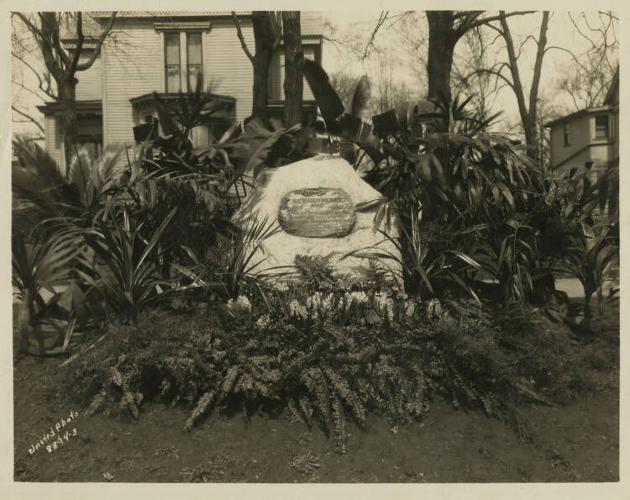
On May 4, 1957, Hovey’s 93rd birthday, Dartmouth alumni unveiled a memorial boulder at his gravesite in North Andover, Massachusetts. Quartets performed several of Hovey’s songs to remember the man known as “Dartmouth’s Poet Laureate.” In 1931, Chicago-area Dartmouth alumni placed a memorial boulder at the Hovey home on West Mulberry Street. The home no longer stands, but the boulder remains, as does the legacy of Hovey’s poetry, over 125 years later.
Saxon summarizes that in his short life, Hovey “achieved a notoriety that few American poets would surpass.”
Tom Emery is a freelance writer and historical researcher who, in collaboration with Carl Kasten ’66, co-authored the 2020 book Abraham Lincoln and the Heritage of Illinois State University.


