


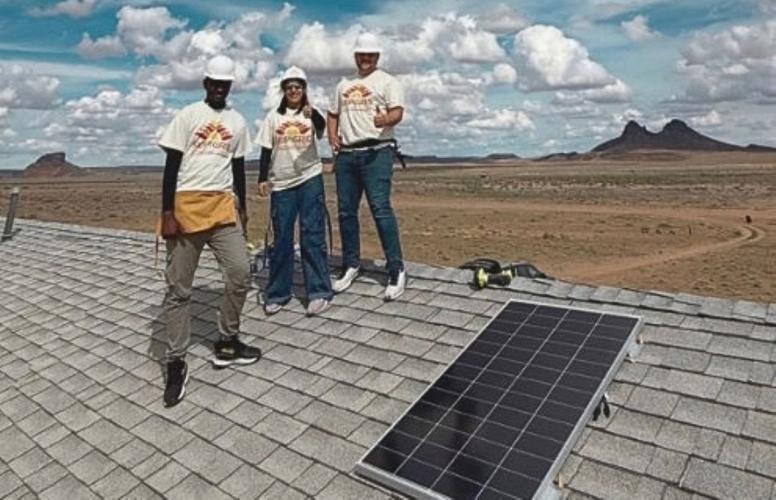
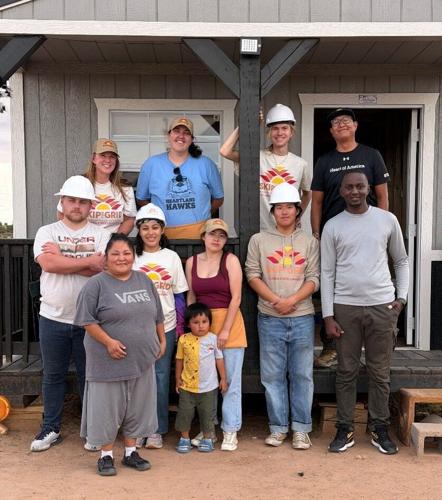
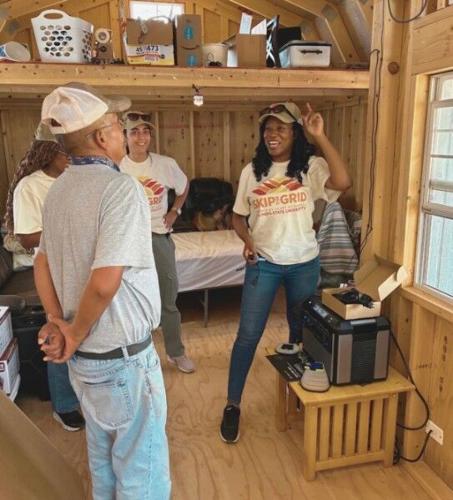
Nine Illinois State University students and two Heartland Community College students recently traveled to the Navajo Nation to install off-grid solar power systems for families living without electricity.
The project was completed through Heart of America’s Skip the Grid program, an initiative co-founded with acclaimed Navajo photographer, humanitarian, and solar advocate Mylo Fowler. Fowler, who will serve as the keynote speaker at Illinois State University’s 2027 Earth Day Breakfast, helped launch Skip the Grid to bring sustainable light and power to off-grid families across the reservation.
The delegation was led by a collaborative team of university and college leadership, bringing together Illinois State’s Director of Sustainability Elisabeth Reed and Dr. Srishti Slaria, assistant professor of economics, alongside Heartland Community College’s Jordan Weth, director of industrial technology laboratories, and Renee Collins, professor in career and technical education.
People are also reading…
They guided an interdisciplinary group of students representing sustainable and renewable energy, economics, construction management, chemistry, and environmental systems science and sustainability majors. Three international students also joined the trip, adding global perspectives to the group.
For students, the journey provided a rare opportunity to put classroom knowledge into practice while confronting a sobering reality often taken for granted: daily access to electricity. Across the Navajo Nation, thousands of residents still live without connection to the electrical grid. Many homes are situated in remote rural areas where extending traditional utility lines can take years and cost tens of thousands of dollars. In other cases, homes may have interior wiring but lack the infrastructure required for a standard grid hookup.
For families in these conditions, the day-to-day impact is profound. Schoolchildren frequently travel hours to and from school only to return to dark homes, making it difficult to study, complete homework, or charge essential learning devices after sunset.
That is precisely where Skip the Grid makes a difference.
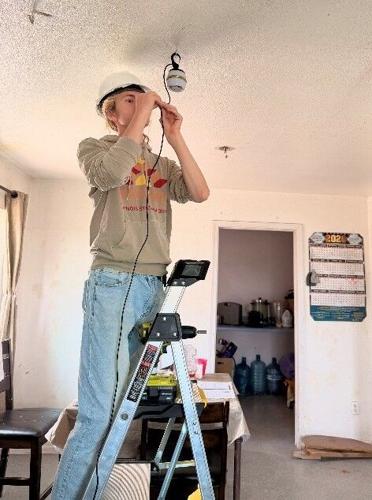
Instead of waiting years for utility lines that may never reach these remote areas, Skip the Grid sets families up with immediate, reliable solar power right where they are. Each family receives a Goal Zero kit featuring two solar panels, two LED interior lights, and a 1,500-watt battery power station equipped with standard AC outlets and fast-charging USB/USB-C ports. The system also includes an energy-efficient refrigerator/freezer that plugs directly into the battery, creating a simple, user-friendly, plug-and-play solution.
Working in coordinated teams, Illinois State and Heartland students performed full-system installations. While one group mounted the solar panels on the roof, another set up the interior battery unit, connected the wiring, set up the lighting, and plugged in the refrigerator/freezer. For students studying renewable energy, bridging the gap between textbook theory and physical installation proved transformative.
“I’ve learned about renewable energy in my classes, but actually installing a solar system and seeing it provide power to someone’s home was completely different. It made everything I’ve been learning feel much more real,” said Sean Thummachart, Illinois State sustainable and renewable energy student.
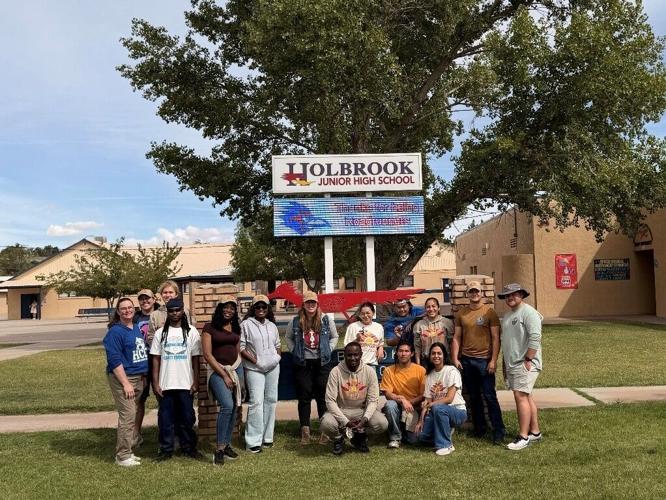
On the third day of the trip, the team shifted focus toward community education and large-scale renewable infrastructure. The students visited a junior high school near the reservation to present on solar energy and help local students build miniature solar-powered cars. That same day, students visited a new SOLV Energy solar farm currently under construction. Spanning five miles and featuring nearly one million solar panels, the facility gave students an up-close look at utility-scale clean energy.
Beyond technical installations and infrastructure tours, spending time on the reservation immersed students in Navajo culture and contemporary daily life, opening eyes to both cultural nuances and systemic energy disparities. Drake Bailey, a junior at Illinois State studying renewable energy, found that the cultural immersion equaled the technical experience.
“While learning how to actually install everything was great, I found that learning more about life on the Navajo Reservation was even more meaningful,” Bailey said. “It was especially interesting hearing about modern culture and learning what sports were popular at their local schools.”
For Rachel Gress, an environmental systems science and sustainability major at Illinois State, the stark reality of off-grid life was a powerful wake-up call.
“I knew we were going to homes without power, but seeing the reality of it was much more eye-opening,” Gress said. “I take for granted all that I can access without thinking twice about it.”
The interdisciplinary and cross-institutional collaboration proved to be one of the trip’s greatest strengths, allowing students and faculty from different disciplines, backgrounds, and countries to witness firsthand the immediate impact of their work.
Recalling their very first installation as night fell, Jordan Weth, director of industrial technology laboratories at Heartland Community College, shared, “I knew we were bringing electricity into people’s homes, but most of the installations happened during the daytime. It wasn’t until our last installation of the day that my perspective changed. We started the installation as it was nearing sunset, and then we quickly found ourselves working in the dark. It’s hard to put into words just how different it felt experiencing that darkness in person. There is no ambient or street light. Just a very big, dark sky and the moon. Knowing this is every evening for these families is something that I’ve thought about each night since. I have taken so much of my life for granted, and this really put things into perspective.”
Illinois State chemistry student Genesee Perez echoed that sentiment, emphasizing how the experience redefined her understanding of energy equity.
“I truly learned what it means for people to lack adequate access to electricity,” Perez said. “I understood the concept in words but seeing it in person put everything into perspective.”
The initiative was made possible through generous grant funding from Constellation and Siemens. The partnership between Illinois State University and Heartland Community College expanded the project’s scope, enabling a larger, multidisciplinary cohort to participate.
“Not only is civic engagement a core value at Illinois State, but we see every day across campus how passionate our students are about sustainability no matter what their major may be,” said Reed. “And Skip the Grid gives them an opportunity to put both civic engagement and sustainability into practice. They’re learning about renewable energy, experiencing a new culture, problem-solving together, and contributing to something that has a real impact. We’re incredibly grateful to our campus partners, Constellation, Siemens, and Heart of America for making this experience possible, and especially to the Navajo people for welcoming us into their community and allowing us to play a part in this meaningful project.”
Each completed installation concluded with a simple yet profound moment: the flip of a switch and a brightly lit home. For families, it brought immediate, life-changing power; for students, it offered a clear picture of how renewable energy can transform communities. Following the trip’s success, Illinois State and its partners plan to return to the Navajo Nation with a larger team to power even more homes in the future.


