

In late July 1861, a local Baptist Sunday school held a picnic on Bloomington’s southwest side at what was then called Miller’s pasture. Although this sylvan 43-acre tract was a favorite retreat for weary city folk, it would take another quarter-century for the pasture to become a public park.
Miller Park is neither Bloomington’s oldest (it’s second behind Franklin Park) nor the largest (second again, behind White Oak Park), yet it remains, all these years later, the city’s loveliest and most iconic, a place where area residents of all stripes can wile away an afternoon in relative quietude.
Miller’s pasture, named for the family of merchant, landowner and state treasurer James Miller, featured a partially wooded, slightly rolling topography and several natural springs bounded by Summit Street to the east, Wood Street to the north and Morris Avenue to the west. The Pantagraph described the undeveloped ground as “one of the loveliest spots anywhere.”
People are also reading…
By March 1887, the Miller family was offering to sell their “pasture” to the city for $17,000 (or more than $400,000 today, adjusted for inflation). Back then, Bloomington’s entire park inventory consisted of 30-year-old, 4.8-acre Franklin Park, a somewhat embarrassing state of affairs that, by the 1880s, resulted in increasing support among city leaders and residents for more park acreage. In fact, there were two competing park expansion plans in 1887, with those on the southwest side backing Miller’s pasture, and those on the northwest supporting the purchase of a wooded tract known as Major’s Grove.
To settle the matter, the Bloomington City Council placed two related park measures on the April 18, 1887, municipal election ballot. First, voters had to decide if they supported or opposed the issuance of bonds for the purchase of parkland and, second, whether they preferred those bonds to go to the acquisition of Miller’s pasture or Major’s Grove.
Southwest-side residents, interested in both expanded public recreation opportunities and increased property values, formed a committee to lobby voters. Such politicking couldn’t have hurt, because both referendums backed by the group (“for parks” and “for Miller’s pasture”) passed by lopsided majorities.
Although the City Council agreed to secure bonds to purchase the Miller property, those living on the southwest side were called upon, via a subscription drive, to donate additional funds to complete the purchase. In the end, the city covered $12,000 of the sale price while local citizens ponied up the remaining $5,000.
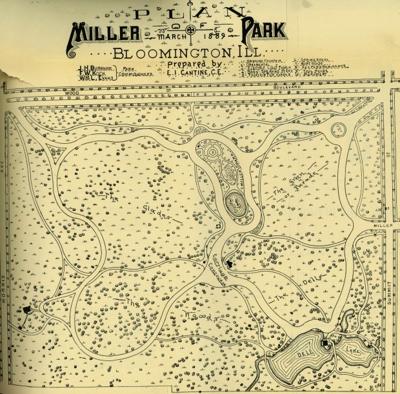
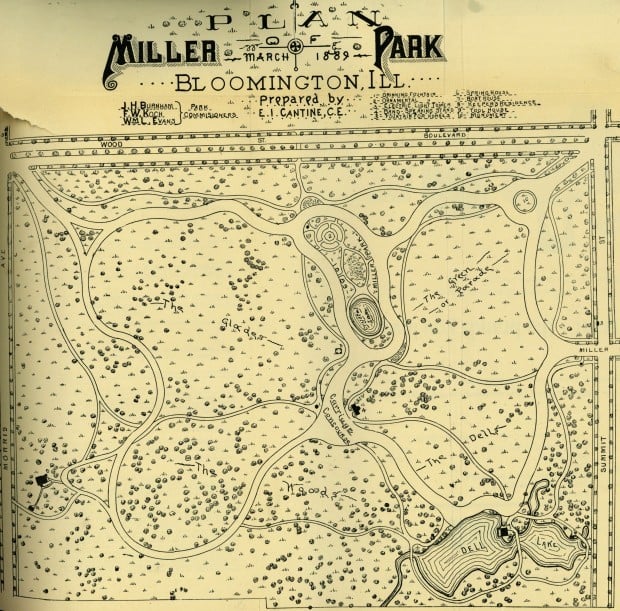
In early 1889, the city’s three park commissioners unveiled an ambitious landscape plan (see accompanying image) that favored natural over formal design. This proposal recommended saving as much of the timber that dotted the southern and central sections of the new park as possible, adding only native flora found in nearby Blooming Grove. In addition to “The Woods,” the park was to be divided into three other quadrants with similarly descriptive names, including “The Dells,” which would feature a small man-made lake.
The commissioners, though, well understood that there were precious few dollars in city coffers to pay for such a visionary plan. In the end, Miller Park’s gradual development incorporated a hodgepodge of various proposals and projects (many funded by donations) implemented over the following decades.
Regardless, the new park was an immediate success. “It is now apparent to everyone that the park is an invaluable acquisition to Bloomington, and it is a pleasure to see the people enjoy it,” remarked The Pantagraph.
In 1896, the city created a lagoon-like lake by damming the small creek (as envisioned in the 1889 plan), and added, six years later, the much-larger lake to the south. After a series of land buys over the years, the park has grown to 67.6 acres.
Despite perennial funding woes and de facto racial segregation (in the early 1900s, park commissioners created separate beach facilities for African Americans, a disgraceful arrangement that lasted into the 1950s), Miller Park has always been a place where Bloomington residents from all walks of life gather for family reunions, church picnics, softball games, quiet afternoons of fishing and Independence Day fireworks.
From early on, many Bloomingtonians appreciated the vital role parks can play uplifting the commonwealth. “Such an institution is a great leveler of social distinctions and as such is highly commendable — necessary, in fact,” one observer noted of Miller Park in 1896. “Rich and poor meet there on common ground and it is equally free and enjoyable to all and taken advantage of by all classes of people.”